
By: Sanad Sahelia
Amid a severe humanitarian crisis triggered by war and deteriorating living conditions in Gaza, the West Bank, and Jerusalem, the Latin Patriarchate, together with its staff, teams, and affiliated institutions, has emerged as unsung heroes in humanitarian efforts. Their responsibilities went far beyond traditional aid distribution, encompassing fundraising and the responsible management of resources to ensure continuity of support and that assistance reached those most in need.
Between November 2024 and October 2025, the Patriarchate delivered large-scale humanitarian aid across Gaza, the West Bank, and East Jerusalem, exceeding 1,500 tons and benefiting approximately 200,000 people. Its comprehensive programs covered food, healthcare, education, employment opportunities, and support for infrastructure and essential services. This effort formed a holistic approach to alleviating the escalating crisis across all segments of society.
These efforts were not confined to a specific period. They trace back to the early months of the war in Gaza, when the Patriarchate began providing essential aid to the most affected families. This included food and hygiene supplies, alongside the coordination of additional shipments for Christian and neighboring communities. This early and sustained support helped ease the suffering of the population, preserve their dignity, and laid the foundation for the expanded humanitarian campaigns that followed. It underscores the Patriarchate’s enduring commitment to accompany the people of Gaza in the most challenging circumstances.
The Patriarchate’s initiatives distinguished themselves not only by logistical and organizational capacity but also by encompassing humanitarian and diplomatic dimensions. It conducted extensive fundraising campaigns, carefully managed resources to ensure continuity, and played a role in local and international mediation to protect civilians and affected communities while supporting Christian and displaced families. Much of this work was carried out away from the media spotlight, preserving the privacy of those affected and ensuring smooth humanitarian operations.
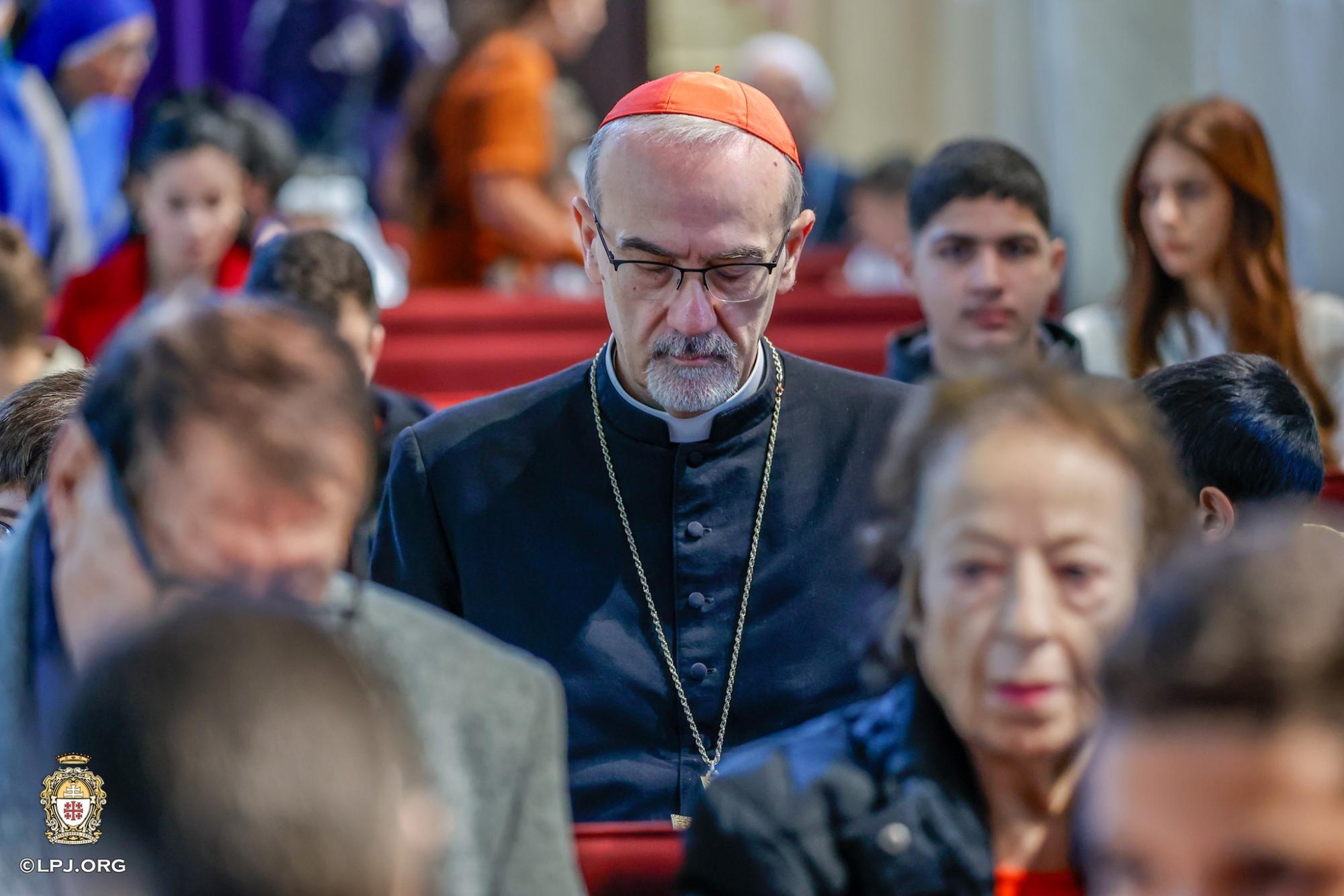
Since the Israeli war on Gaza in October 2023, Cardinal Pierbattista Pizzaballa, Latin Patriarch of Jerusalem, has made four visits to Gaza. His presence on the ground was direct and supportive, reaching people under the harshest conditions. These visits conveyed a clear message of solidarity and pastoral care. He went straight to the heart of the crisis at a time when many others had withdrawn or were managing the situation from afar. These visits allowed the Patriarchate to closely monitor humanitarian needs, support immediate relief efforts, and strengthen trust between the Christian community and local populations, reaffirming its commitment to accompany residents and alleviate their suffering in Gaza through practical, sustained action, far from media attention.
In Gaza, the Latin Patriarchate’s Church of the Holy Family complex became a fully integrated humanitarian hub. The Patriarchate provided over 1.2 million meals to displaced persons within the complex and surrounding areas, and met the basic needs of roughly 10% of northern Gaza’s population. Additional services included a field bakery, medical clinic, water wells, solar energy systems, and laundry facilities. Educational programs and employment opportunities for about 200 individuals were also provided, helping families maintain dignity under extremely difficult conditions.
In the West Bank and East Jerusalem, the Patriarchate focused on preventing the collapse of households and community structures. This included creating employment opportunities through wage and training programs, distributing food vouchers, supporting small businesses affected by economic stagnation, and providing healthcare and medications. Education was secured for approximately 5,000 students, housing and rental support for over 4,000 families, and aid for infants and winter assistance for thousands of beneficiaries. These interventions helped maintain social stability and preserve the dignity of the most vulnerable families.
Cardinal Pizzaballa stated: “In these times, the Church has experienced that mutual trust opens our eyes to see reality constructively and positively. When trust is absent, our eyes close, and we lose the ability to discern rightly. The trust that arose amid suffering has made us realize that we are called not only to care for others but also to act with the humility and simplicity of the children of the Gospel.”
It is worth noting that the Patriarchate’s work extended beyond food and aid. It involved careful diplomatic initiatives, building partnerships with local and international organizations, and discreet efforts to safeguard the historical artifacts that narrate Gaza’s rich history. Programs also supported the most vulnerable families psychologically and socially, with sensitivity to the delicate humanitarian circumstances. Much of this work was conducted away from public attention, reflecting the Patriarchate’s commitment to dedicated, unseen action, where the focus remains on results and on people rather than public recognition.
While challenges remain significant, the Latin Patriarchate confirms that it will continue to intensify its relief, educational, and development interventions in 2026. It remains close to the poor and the afflicted, rooted in the vision of a Church that accompanies its people through their suffering while protecting human dignity and sustaining hope for the future.