
In the Holy Land Today: Simon of Cyrene Carries the Cross With Us, and Veronica Preserves the Face of Truth
By Sanad Sahelia
Two thousand years ago, Jesus walked through the streets of Jerusalem carrying His cross, not only a piece of wood but the wound of humanity itself when dignity is taken away before life. He was humiliated, spat upon, scourged, and stripped of His garments before being raised on Calvary. These were not merely events before His death, but a journey revealing the tragedy of human beings stripped of their dignity.
Today, in the same land that witnessed these events, Palestinians, including Palestinian Christians, continue to live a reality that carries painful echoes of that road. This is not a claim that history is repeating itself in the same way, but an attempt to understand how injustice returns whenever human dignity, identity, and the right to remain are threatened, whenever the human face, which Christian faith sees as bearing the image of God, is disregarded.
In Jerusalem, recent years have witnessed attacks against priests, monks, and nuns, as well as acts of desecration targeting holy sites and religious symbols. For Christians, these images recall the humiliations before the crucifixion. Spitting was not merely an insult, but a denial of human dignity. Likewise, attacks on sacred places affect not only stones, but memory, identity, and faith.
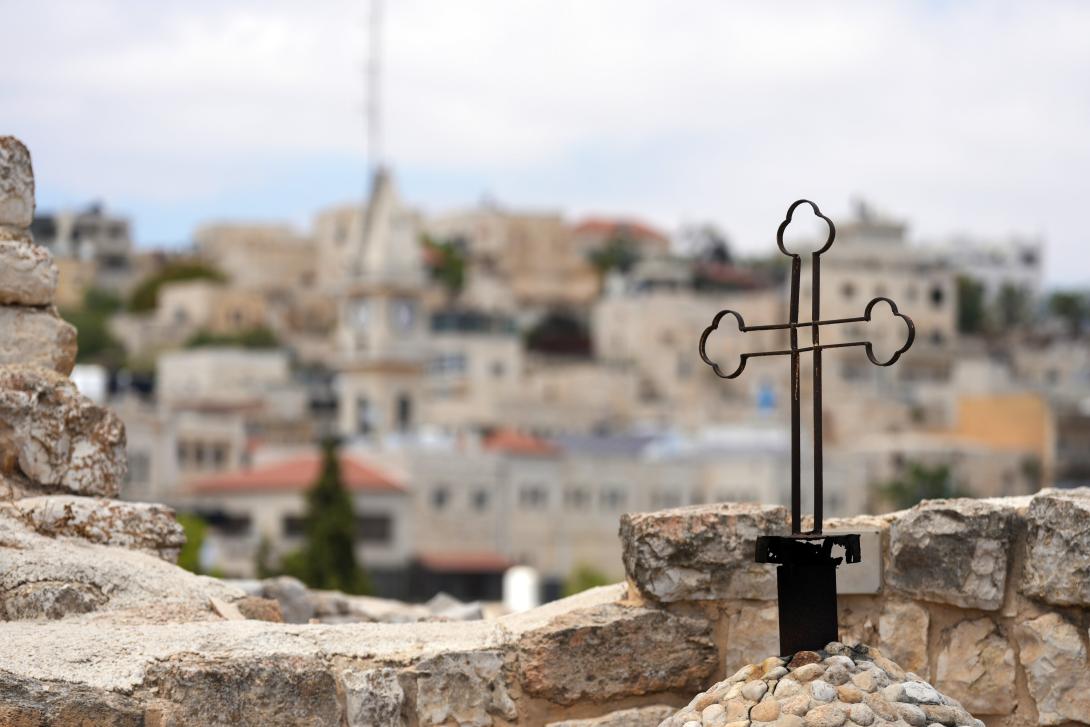
In the Holy Land, Christians today do not carry a wooden cross on their shoulders, but another cross: the memory of a community that fears losing its roots in the land where the first Christian communities were born and where the Church’s witness began. Behind every church or sacred site subjected to insult are human faces, people with names, stories, prayers, and memories, not merely silent stones.
In the Passion narrative, the Gospels recount how the soldiers divided Jesus’ garments and cast lots for them at the foot of the cross. The scene was not only about clothing, but about a deeper act of stripping away, taking from a person the last symbols of dignity and belonging.
Today, when Palestinian lands are confiscated and settlement outposts expand, particularly pastoral outposts that have grown in recent years across the West Bank, many Christians feel that part of their historical memory and continuing presence in the Holy Land is under threat.
In Taybeh, the last fully Christian Palestinian town in the West Bank, whose Christian witness reaches back to the earliest centuries of Christianity, losing land means far more than losing soil. The land is family memory, olive trees, fields inherited through generations, and part of a continuing Christian presence in the land of the Gospel.
For this reason, the image of soldiers casting lots for Jesus’ garments appears again in a contemporary political language. Circumstances may change, but removing people from their land, memory, and belonging remains a wound that touches the image of God within the human person.
This symbolism becomes even more powerful when attacks reach churches and cemeteries, as has happened in Jerusalem, Taybeh, and other places that preserve the memory of Christianity in the Holy Land and the wider Christian East. The wound inflicted on Jesus after His death was not part of the sentence itself, but an additional act of violence and humiliation. In the same way, attacks on sacred places today do not only damage buildings, but leave wounds in the memory of entire religious and historical communities.
Perhaps this is what Saint Paul meant when he wrote: “If one member suffers, all suffer together.” In Christian understanding, the suffering of believers is not an isolated experience; it becomes a wound affecting the whole body, the Church in its spiritual and human meaning.
Yet the Way of the Cross was not only a path of suffering.
Amid the crowd appeared Simon of Cyrene, the man who helped Jesus carry the cross. He did not end the suffering or change the course of events, but he refused to remain a spectator. He came closer and carried with the suffering person a part of his burden.
Today, Christians in the Holy Land find their “Simons” in churches, church leaders, institutions, journalists, solidarity movements, and human rights defenders who choose to carry suffering rather than ignore it.
They do not carry the cross instead of the people of the Holy Land, but they carry it with them. This is the deeper meaning of Simon’s role: sharing another’s suffering so that pain does not become isolation.
Pope Francis repeatedly called on the world not to become accustomed to the suffering of the Holy Land, emphasizing that its Christians are not remnants of the past but a living community bearing witness to the Gospel in the birthplace of Christianity. Cardinal Pierbattista Pizzaballa, Latin Patriarch of Jerusalem, has also stressed that protecting holy places cannot be separated from protecting the “living stones,” the believers who give them their true meaning.
If Simon represents participation, Saint Veronica represents witness.
According to Christian tradition, Veronica approached Jesus amid the chaos and wiped His face with a cloth, upon which His image was preserved. She could not stop the trial or change the course of events, but she preserved the truth from being lost.
Today, the Church, professional media, human rights organizations, civil institutions, and activists defending human dignity become a new Veronica, documenting events, sharing testimonies, and preserving the face of truth. As Veronica’s cloth preserved the face of Christ from being forgotten, truthful witness preserves the human face from being reduced or erased.
This reflection is not a call to use sacred symbols as political slogans, nor to invoke the past at the expense of the present. It is an invitation to view today’s reality through the values of the Gospel: human dignity, justice, mercy, and the rejection of injustice.
The words of Jesus in the Gospel of Matthew give this reflection its deepest meaning: “Whatever you did for one of the least of these brothers and sisters of mine, you did for me.” Defending those who suffer, regardless of their identity or background, is not only a political position, but a moral and human responsibility.
Despite the pressures that lead many to leave, Christians in the Holy Land do not see themselves merely as victims, but as witnesses to a living presence. Their remaining is a message, their perseverance a testimony, and global solidarity a sign of hope.
Therefore, the Resurrection remains the final word.
The road to Calvary did not end at the tomb, but in life. As Veronica preserved the face of Christ for generations, and as Simon carried the cross alongside the Crucified One, the world today is called to preserve the truth of what is happening and to share in protecting human dignity, so that the land where Christianity was born remains a land where its people can live, not merely a museum of sacred memory.